
A modest, redeveloped vineyard at a high school in Sydney’s Northern Beaches will soon be an unlikely home to disease-resistant grapevines that have been developed by CSIRO, Australia’s national science agency, in a long-running breeding program supported by Wine Australia.
Located in Mona Vale, just a couple of kilometres from the coast, Pittwater High School runs the only agriculture program in the local area. As part of a recent refresh of the program to incorporate viticulture, the school has revived a space that had historically been planted to vines more than a decade ago but more recently had been used to graze sheep.
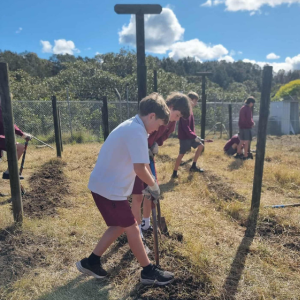
Last year, a group of Year 9 students planted out the space — which measures approximately 10 metres by 15 metres — to primarily table grapes, specifically Golden Muscat and Black Muscat.
“The students have done the bulk of the work to bring the vineyard back to life,” said Pittwater High School’s agriculture teacher Tamara Cole. “There’s a real sense of pride in what they’ve created.”
.png "Untitled-design-(22).png")
Keen to add winegrapes to the vineyard, Ms Cole reached out to Wine Australia for some advice on what to plant given Pittwater High School’s humid, coastal conditions.
“We’re only a stone’s throw from the water, so humidity is a real factor and disease pressure is something we have to think about,” Ms Cole said. “I wanted to understand what varieties might realistically work here.”
Wine Australia’s senior program manager Dr Sharon Harvey connected Ms Cole with the CSIRO, which facilitated access to the grapevines with resistance to powdery and downy mildew. The result is that a handful of first-generation vines of Riesling origin will be planted in the vineyard this spring.
The agriculture program at Pittwater High School is supported by the school’s farm assistant, who is also a viticulturist.
Ms Cole said the program had also taken advantage of the free resources on www.wineaustralia.com/careers to support students’ learning about viticulture.
She added the vineyard had unexpectedly attracted the interest of the school’s high-potential students.
“The vineyard is catering to students who like to be hands-on as there is so much to do in the vineyard day to day. It also appeals to students more broadly, including those who are drawn to the science and more technical aspects of running a vineyard,” Ms Cole said.
Dr Harvey said it was great to see science, education, sustainability and industry research intersecting in the high school vineyard.
“It’s demonstrating how the grape and wine sector is responding to disease and climate challenges, how research can translate into day-to-day practices and, hopefully, is encouraging students to see viticulture as a future career pathway,” she said.
Using traditional breeding techniques, CSIRO’s disease-resistant grapevine breeding program has been underway since the 1990s and is aimed at reducing the wine sector’s reliance on fungicides while maintaining grape and wine quality.
The first generation of varieties (known as Gen 1) carry one gene each for resistance to powdery mildew and downy mildew. They are performing well in industry trials in several regions, showing strong resistance to mildew under a ‘minimal-spray’ program.
A second generation (Gen 2) of grapevines combines two resistance genes each for powdery mildew downy mildew for more durable protection, and selections are currently undergoing trials in ‘no-spray’ vineyards.
“Although not a typical partner for evaluation, the provision of one of the CSIRO-bred grapevine lines designated for commercialisation to the Pittwater High School supports the school’s aim to foster student engagement in plant sciences,” said Dr Jason Geijskes, Group Leader – Trait Innovation, at CSIRO.
“This aligns with CSIRO’s ambition to engage and inspire young Australians on the real-world applications of science."